I’ve been waiting to hear the buzz about the “Lone Ranger” movie from folks out in Indian Country. Magazines like Cowboys and Indians and Native Peoples have been politely neutral. I suspect the decision has been to appreciate that American Indians at least get some pop culture notice, and that Johnny Depp has been fairly respectful of Tonto, even going so far as to intimate he himself has some Native blood.
One tweet I saw recently said that Depp is talking with the Oglala Sioux about buying Wounded Knee, since that sacred site of heartbreak is up for sale in this oh-so business-like world we inhabit.
I wasn’t sure what to make of the movie when I saw it, but I decided I liked it, especially the ending scene which occurs after the closing credits start. (By then most of the handful of people in the theater had walked out, so they missed it.) If I said the movie was uneven, that would be a good judgment. The critics panned the movie and it hasn’t brought in the money Disney had hoped for, but I still wonder what Native America thinks about it…
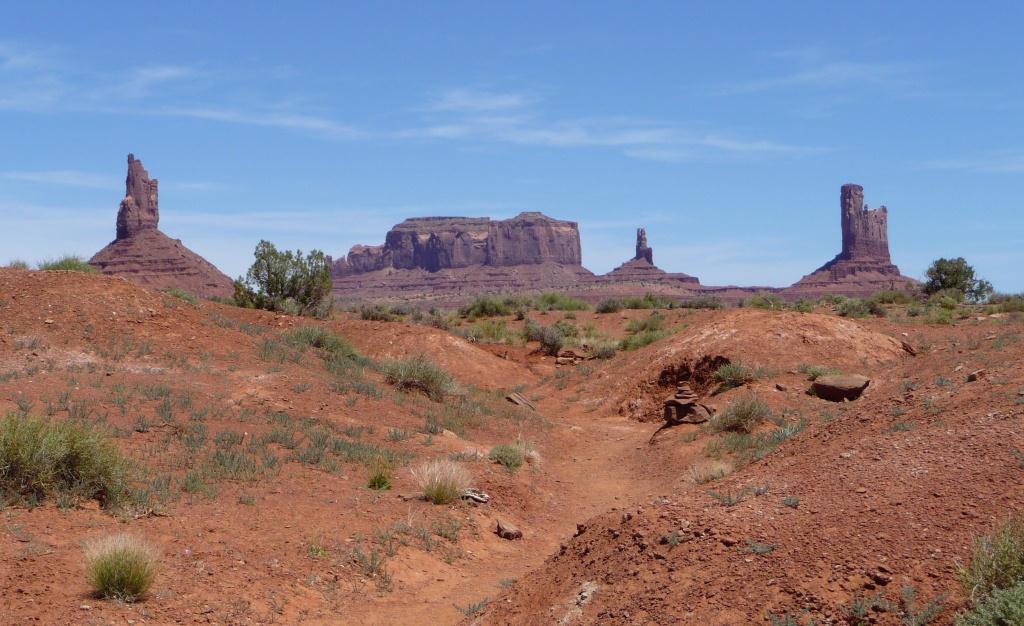 Monument Valley, where lots of “The Lone Ranger” was filmed.
Recent travel articles in The New York Times and some magazines invariably depict some view of Monument Valley when extolling the glories of the Navajo reservation. Covering nearly 100 square miles, the area’s 30,000 acres became a Navajo Tribal Park in 1958. Before that, in the 1930s and 40s, John Ford made the place famous in his Hollywood movies. In fact, if we called Monument Valley iconic, we wouldn’t be wrong.As landscapes go, this one is rightly associated with Indian Country in people’s minds.
Its sheer scope, along with isolated mesas and buttes, was sculpted in the Cenozoic era when the region was under water. When the sea receded, what remained left behind were beds of sand. These hardened and compacted into the hundreds of stone formations so beloved of photographers.
Countless writers and journalists speak of the magic of the region, and how visiting this area clears their heads from every day cares and distractions. One personal note: after brain surgery in early 2002, I decided I wanted to go to Monument Valley for just those reasons later that year. What I had forgotten, however, is that it sits 4800 to 5700 feet above sea level. I had a wonderful time, except for the headaches!
Our eyes were caught by a small article in the June issue of Cowboys and Indians. Written by Sandy Yazzie Tsosie of Kayenta, clearly a local resident, it is a delightful survey of what it would be like to camp overnight on Hunts Mesa at the Monument Valley Tribal Park. The experience requires four-wheel-drive and a permit, but sounds like something that would make a great memory. The vast sky overhead changes so much over a twenty-four period, that it’s like watching a pageant. Get information at www.navajonationparks.org/htm/monumentvalley.htm