There’s a place in the Southwest that allows a whole new view of Apache art. For those touring southeastern New Mexico, a stop at the Inn of the Mountain Gods Resort and Casino in Mescalero, New Mexico, provides a feast for the eyes. This resort, renovated and reopened in 2005, contains original works of art by Apache artists along the inn’s eight-story walls. Apache design is the theme, including the larger-than-life bronze statues of crown dancers by Fredrick Peso. Two major artists of Apache heritage, Allan Houser and Larry Vasquez, remind us that there are more perspectives out there than the familiar Navajo and Pueblo and their aesthetics.
For those traveling in Indian Country this summer, investigations of Indian arts will often uncover objects made for humorous purposes. Native peoples, including those of the Southwest, have long honed an ironic stance toward life. When the Institute of American Indian Arts opened in 1962 in Santa Fe, its most notable young painters expressed their rage, anger, and irony in marvelous compositions. Artists like T.C. Cannon and Fritz Scholder painted young Natives with the American flag draped around their shoulders like a poncho. They depicted Indians at bars wearing bleak faces and quietly roasted the oblivious white patrons who boosted Indian artistic fortunes. Indian “folk art” performs the same role by showing that traditional Indians are more conversant with modern desires than many tourists realize. Just go to any McDonald’s in Four Corners Country and you’ll see this at once.
This prime example from a museum in the Northeast shows us a fine Navajo-made squash blossom necklace using American currency (silver dollars) for ornamentation. The earlier generations of Native smiths used U.S. and Mexican coins for their metal until this practice was firmly banned by the federal govenment in mid-century. Beautiful necklaces were crafted between the 1920s and 1950s and became enjoyable souvenirs to be brought back home and worn for their amusement value. Yet these pieces are also fine examples of Native exploration with design. Humor has to be an underlying impulse: Indians would grow to understand that such currency was essential for living in the modern world.
At this point, a collector finds that he or she is ready to entertain the idea of people — the object’s creators. It can be embarrassing to admit that one collects for a period of time without thinking about the creators, but many collectors admit that this is precisely what they have done. Many times, collectors begin to forge bonds with their suppliers. These dealers, vendors, and shop owners often suggest artists to meet, and then collectors start on the show circuit.
I still remember a crucial moment, about four years into my collecting, when a Navajo gallery dealer quietly advised me to take a good look at the people who made objects I wanted to purchase. I followed through at the Gallup Intertribal Ceremonial, and I learned that those objects I loved so much had people behind them.
Well, now the collector is amassing objects, and has begun to sort out some personal feelings about what is wanted and needed for a collection. The educational process begins around this point. I discovered that if I was going to spend my money like a drunken sailor, I did want to know more about the materials my object of desire was made with. For me, this meant learning about silver — coin silver, German silver, sterling silver, silver with alloys. Oh, and then, there’s the turquoise…
Books are needed! Once the collector becomes truly primed, the need to learn, evaluate, and judge based on knowledge becomes a driving force. In my case, it led me to begin writing on the subject when the variety of books out there wasn’t enough to satisfy my questions. Today, Amazon and the online used book market make the hunt for education an easier process than it was back in the 1980s.
One object isn’t enough, oh no! The new collector is ready to embark willy-nilly on a hunt for objects like the ones in his/her possession. Frankly, new collectors can’t get enough exposure to these objects. If you don’t live in the Southwest, you comb through local shops, dealers, and shows. It only took one trip for me to realize that big successful enterprises like the Brimfield (MA) antique shows are NOT the place to find one’s objects of desire. A savvy dealer has been there the day before and taken anything of note. New collectors need to understand these realities before expending too much manic energy in fruitless hunts.
Sometimes hunts prove beneficial after the fact. We started visiting trading posts on the Navajo reservation in the late 1980s and early 1990s. Some had already stopped being genuine sources for Indian arts. Yet we discovered an affordable and fantastic rug at the Crystal Trading Post and a saddle blanket at Shonto, and learned about the historical importance of trading posts, even though their day had passed by the mid-1970s. New posts, operating like galleries are less plentiful, but when you hunt down one like Twin Rocks Trading in Bluff, Utah, it’s like hitting a bulls-eye!
I’ve been working on a project related to why we become collectors. Certain interconnected things happen during this process. Having been through this, even though it was back in 1986, I still remember each development unfolding as clearly as if it took place yesterday.
Collector passion begins between a human being and an object or group of objects. I call this a first phase (a pun on the name of a period when antique Navajo weavings were first made.) The focus of the collector passion – a state of intense consumer desire – is on that object. For me, it was an Indian-made ring. Others make the discovery that their passion flares for a katsina carving, a clay pot, a piece of intricate beading, etc. Yes, we are talking about an inanimate object, something created.
A trip to Tucson for those touring Indian Country should take in Grey Dog Trading Company. Run by Kent McManis, the Native-made stone carvings you find here are chosen by THE expert. McManus and his wife have authored a number of key reference publications on Zuni stone fetishes. Their research and knowledge of the subject are prized by collectors around the country (one from New York City called during one of our visits). McManus personally knows virtually all the carvers of Zuni Pueblo, and has worked over the years to trace and place key artists within their complicated web of family relationships.
McManus has a limited amount of jewelry in his shop, a careful selection of fetishes (he travels to Zuni every month), and in recent years has begun carrying a small but remarkable number of Inuit carvings. Every piece in Grey Dog Trading has been chosen by someone with a master collector’s discerning eye.
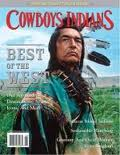
Cowboys and Indians is one of the most popular glossy magazines on the market, and has high circulation numbers. We enjoy looking at the magazine for its intriguing articles on the western lifestyle and its sumptuous color advertisements. The popularity of Cowboys and Indians, however, also reminds us of the need for clarification. Many people see jewelry that looks like contemporary Native American designs and draw the conclusion that this adornment is Native-made. In many cases, it’s simply not so. Non-native silversmiths and jewelers work in a design mode that can be variously labeled “Southwestern Style” or “Santa Fe Style.” This mode shares many similarities to Indian-made jewelry, especially in terms of jewelry forms like bracelet cuffs, rings, and bolo ties. One major non-Native designer of note is Rocki Gorman, who now has a boutique inside the famed Hotel La Fonda in Santa Fe.
One of the best things about Native-made textiles is in the detail. Today’s weavers use opportunities to pull the viewer in with a small touch. Such an image is often organic, ranging from rain clouds to rabbits. Don’t forget to check out the Crownpoint Rug Auctions if you plan to be in western New Mexico.
Exhibitions like “A Turning Point,” currently at the Heard Museum, point out essential information. Navajo weavings are famed for their unexpected narrative elements, usually in keeping with the overall design.