If the Indian arts shows are factored out, where can collectors, especially beginners, expect to find the best work? We faced this issue in our visit to Tucson earlier this year. We were looking out for quality Tohono O’odham baskets. The Mission at San Xavier used to be a good bet, but their gift shop held only a few mediocre items. We located a small shop not far from the mission, Turquoise Skies where there was good work available. This shop was run by local men who knew the local artists personally. Even then, however, the owners admitted that getting this work is harder. Not only are fewer Native artists able to take the time to make this art, or teach a new generation, but well-to-do collectors and city dealers come to them first.
What does this tell those visiting Indian Country for a first-hand experience of buying Native arts there? Well, there will definitely be less really good arts available at trading posts and shops near national parks and tourist attractions. The loss of Verkamp’s at Grand Canyon Village on the South Rim is evidence of that. Even the shop at Monument Valley Tribal Park contains items that jump from low-end tourist work to the extremely expensive. If you want good quality Indian arts, your choices—with a few notable exceptions—are to go to the reputable museum gift shops, IACA- and ATADA-backed galleries in the cities, or to the artist directly.
(Disclaimer: While we shop at the Head Museum Shop, we do not receive any gifts or other consideration for mentioning them.)
This rich blue stone is so much more than the official gemstone of New Mexico and the designated stone for those born in the month of December. Turquoise has been part of the American Southwest and its peoples for more than 2000 years. Those who prize turquoise as a collectible, and love it in their Native-made jewelry, realize soon that they need to know more about this stone than the fact that it’s composed from the hydrous phosphate of copper and aluminum.
Not all turquoise is usable: it needs to be sturdy enough to take cutting and polishing. Mines of origin, color, and matrix determine value. Yet natural turquoise, a large part of what determines price for a piece of jewelry with such material, means that this stone hasn’t been treated. Unfortunately, most turquoise today requires some sort of treatment.
At this point, the collector requires some education. Dealers and suppliers are a source for information, but self-education is essential, too. Here the IACA offers some help, with their useful pamphlets. They, too, in turn look to experts, such as those who run the Turquoise Museum in Albuquerque. Located virtually a hop, skip and jump away from the Old Town Plaza, every would-be Indian arts enthusiast should make a pilgrimage there.
By the way, IACA recently announced the award-winning artists from their Spring show. See Liz Rose’s article for details.
During the Scottsdale Art Walk before the Heard Guild Fair, I learned about a new initiative. Some members of the Indian Arts and Crafts Association (IACA) had set up a table to advertise, among other things, that the IACA has created a Collector’s Guild that permits members to attend the bi-annual IACA wholesale shows’ Collector’s Market. After some questioning, I learned that this Market was added onto the two Collector’s Markets, as a means of allowing collectors to view and purchase arts made by IACA members. (Up until now, these shows — which are usually held in Albuquerque and Mesa — had been restricted to wholesalers only.) Proceeds from this new Collector’s Guild will aid the IACA Artist of the Year program.
I have always been tantalized by the arts shown in ads for the IACA wholesale shows; now, there seems to be an opportunity to buy directly from the artists while perusing the latest trends. Check this out at the IACA website; individual membership is $50 annually. It looks as though longtime collectors like me have two new Indian arts show opportunities…
Hi Paula,
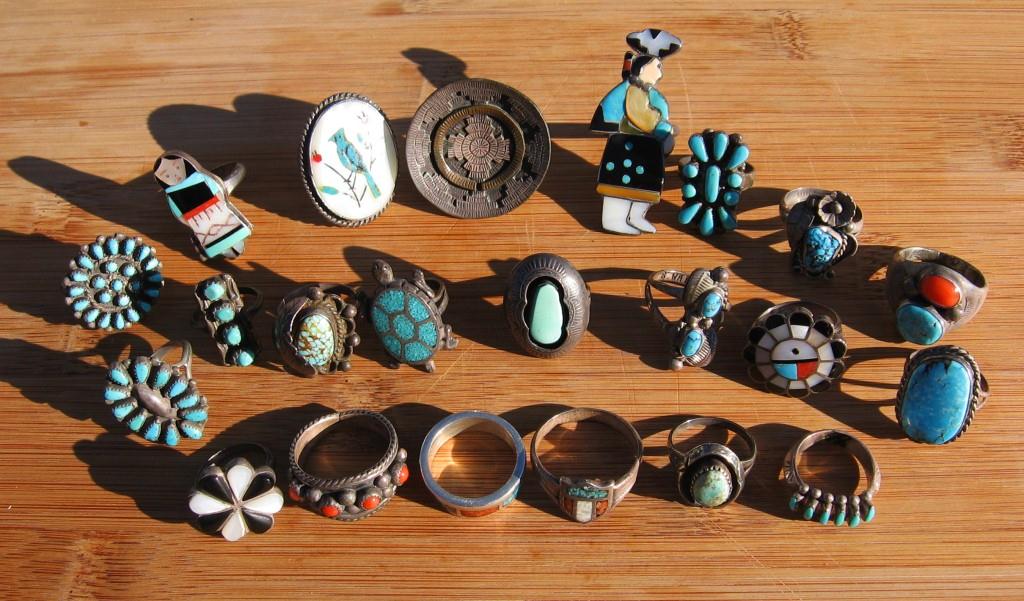
We inherited a whole bunch of Native American jewelry (several hundred pieces in total) from my parents who sold some at a shop in the seventies. I’ve attached a couple of representative pics. About a third to a quarter of them have hallmarks. We would like to sell some of it, but we’re not really sure what we have. Can you help us find someone in the St. Louis area who can give us an idea as to value?
Thanks for your help,
Richard Newton
Southwestern Souvenirs responds:
Dear Richard:
I found some individuals for you who will be able to lead you to the right appraiser. From ATADA (Antique Tribal Arts Dealers Association), I located Joseph Zeller, who is in East Dundee, Illinois, the closest location I could find to St. Louis. He is part of River Trading Post, which operates three stores: in Illinois, Santa Fe, NM, and Scottsdale, AZ. I know this outfit and they are very reputable; he can help you locate an appraiser, or someone at River may be trained to do this. River Trading Post, tel (847) 426-6901 and e-mail: trader@rivertradingpost.com
Closer to you geographically are the following members of the IACA (Indian Arts and Crafts Association), and I have heard of the Native American Trading Company. They, too, will acquaint you with someone who can help.
Native American Trading Co.
Michael O’Cheltree
115 N Main Street
Hannibal, MO 63401-3536
573.248.3451, Fax: 573. 221.4054
Email: natamtrd@sbcglobal.net
Website: www.nativeamericantrading.com
Silver City Trading Post
Richard Sellers, Barb Schnarr
724 S. Main St
St. Charles, MO 63301
636.255.8885, Fax: 636.255.8885
Email: silver_city@sbcglobal.net
The pieces I saw in your photo were quite nice; they look like they range from the 1940s to early 1980s. All of the individuals above will be familiar with this jewelry. The vintage jewelry market has seen a rise in interest lately, but be aware that the pre-1940s pieces in good condition will fetch higher prices. For example, your 1970s items will resell for about $120-$200 roughly, depending on materials and condition. Members of ATADA and IACA are bound by guarantees of ethical practices, which is important when dealing with American Indian jewelry — which has its own black market of fakes and misrepresentation. Good luck! I rather fancied some of those Zuni inlay rings, myself!
Paula