The 2008-9 Great Recession threw many non-profit cultural institutions into a tailspin; funding curtailments brought big changes to operations that had always maintained some measure of continuity. Almost overnight, these organizations discovered that they needed to apply business solutions; some places succeeded in making transitions, while others ended up damaging aspects of their original mission. The Gallup Ceremonial’s problems don’t stem simply from a lack of cash. The event needs to reevaluate the state of Indian arts today, what requirements drive local tourism, and how aiding the local community can be balanced with bringing in more visitors who want to see and participate in something unique and special.
What worked well from the 1920s up to the last quarter of the twentieth century no longer meets the demands of the 21st century. That doesn’t mean throwing out the baby with the bath water, however. The Ceremonial’s directors and sponsors need a new vision of just what can refresh its traditions while creating an added impetus for attending. What exactly brings locals and visitors together? In the past, those who respected Indian culture (like me) enjoyed coming to partake of things that wouldn’t ordinarily be available when just passing through as a tourist.
One idea I hear from those who live in or near Gallup is that the Ceremonial needs to be brought back to downtown Gallup. The SWAIA Indian Market benefits greatly from being held on Santa Fe’s Plaza and adjoining streets. The aura of street festival is hard to beat, and Red Rock Park’s buildings look very tired and in need of structural reinforcement. A place to begin is with the bathrooms: the facilities in Gallup’s busy WalMart look much better than those at the park…
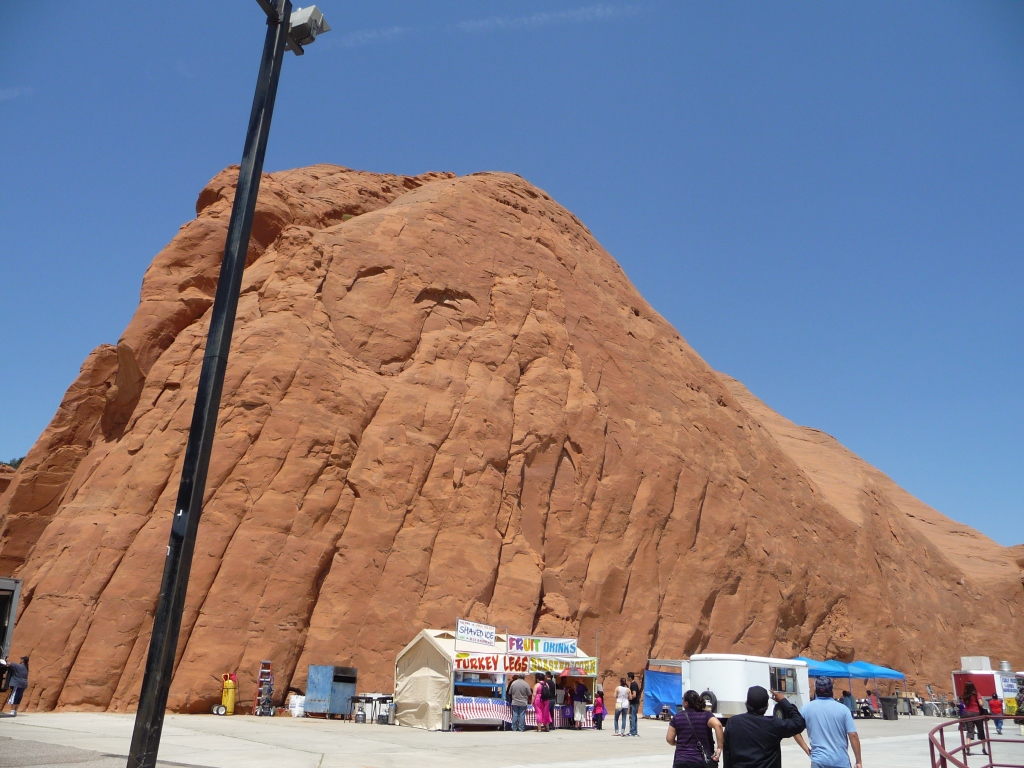 At the entrance to the Gallup Inter-Tribal Ceremonial
Nevertheless, the Ceremonial isn’t dead yet, not by a long road. There are those still loyal to its original premise when founded in the 1920s, that this would be an important venue for Indian arts at their best. What many people forget, also, is that this is an event for bringing Native peoples together. I might prefer a powwow to a rodeo, but there’s entertainment for the locals and the venue can be a source of pride—a destination. I certainly saw this on Saturday morning when we pulled onto I-40 and glimpsed the large, healthy crowd downtown for the parade.
Back in the 1930s, the Indian traders held sway. Newspaper articles in following decades largely gave Native artists short shrift and reported on which trader booth had received the most awards for arts. Patronage has changed, and the list of corporate sponsors is a telling statement about what businesses today can afford to be sponsors. The Arts judges are also leading figures in the field. Later that week,in Santa Fe, I spoke with one judge who expressed some concern about the changing of categories for prizes. This created difficulties for some artists. For example, I saw fewer entries from Zunis than expected. It may be that the Ceremonials sponsors need to clarify and establish less flexible guidelines and attempt a wider range of fundraising.
My summer in the Southwest yielded other stories about institutions reorganizing, sometimes in rather alarming fashion. I discovered in Santa Fe that the Indian Arts and Crafts Association (IACA) had recently eliminated its paid staff for an all-volunteer staff.
At the entrance to the Gallup Inter-Tribal Ceremonial in Red Rock Park
This question has often come up over the years. This year, we were in a position to attend and pulled into the parking lot for the Friday August 9 day of the annual event. There were a lot fewer cars than we remembered. An immediate disappointment arose when we bought our tickets and learned that the powwow had been canceled. The booths along the perimeter of the buildings had Natives selling stuff that was definitely NOT locally made. Inside, things seemed back to normal except for the fact that the interior booths were reduced to a very small number. I remember when the booths lined the entire perimeter of the great hall.
Can we blame the recession? Yes, but there seems to be a more complex string of issues. Those who run and organize the Ceremonial have been plagued by fundraising woes. I recall about five years ago they turned to the state for funding solutions. Ooops! One reality is that the number of active trading posts with powerful followings of artists and collectors has greatly diminished. Trading posts are not what they once were, and Hubbell Trading Post in Ganado AZ may soon be one of the few real remaining relics of this enterprise.
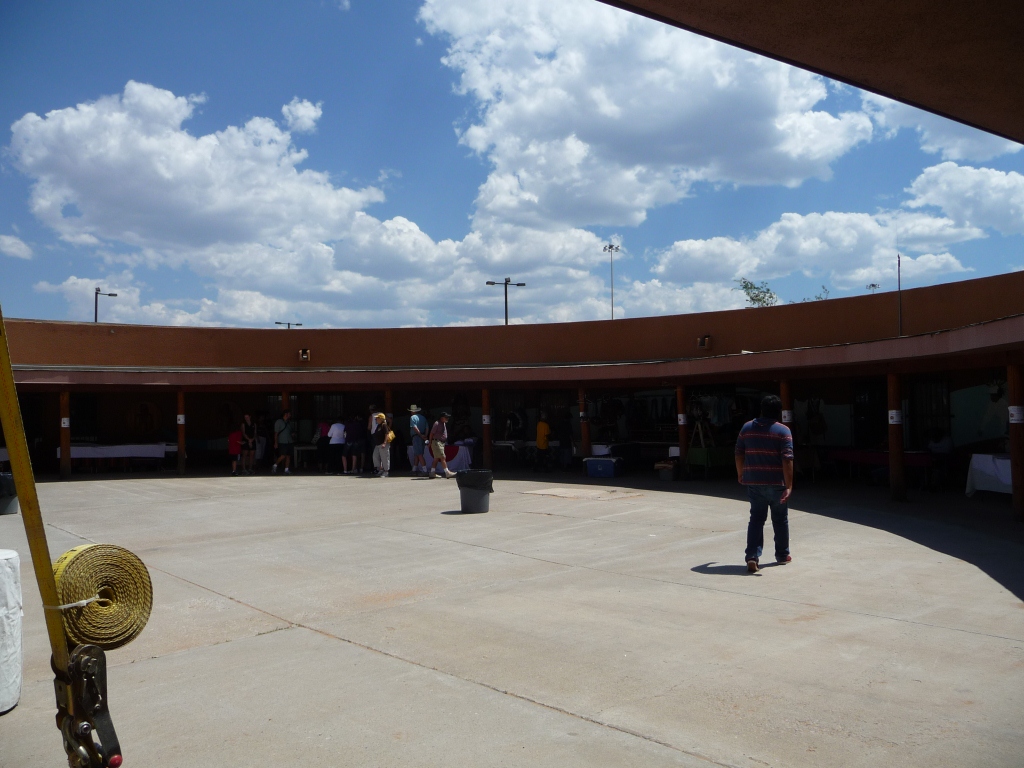 The outdoor booths at the Gallup Inter-Tribal Ceremonial.
The history of American Indian arts is marked by Native reaction to and acceptance of judging, particularly by non-Natives. In the Southwest, this started as early as the 1920s, when the Santa Fe Indian Market and Gallup Inter-tribal Indian Ceremonial were established. In Santa Fe, the first judges were anthropologists and non-Native Indian arts patrons. In Gallup, non-Native Indian traders were the judges. Many Natives, especially those from the Pueblos, were embarrassed and discomfited by judging events. Competitive activities like prize awards didn’t always sit well with Indian neighbors; others, however, claimed that getting awards helped their careers.
Occasionally, the best attempts backfired. A friend of ours, a man in his sixties, speaks of a time when he discovered evidence that one particular award event had been “rigged.” He carried on, didn’t complain, and later when his career was solidly established, he pulled out of that competition for good.
We recently received a report from a usually reliable source about a practice that happens at the Inter-Tribal Indian Ceremonial, held in Gallup at Red Rock State Park. This event most often takes place the week and weekend before the SWAIA Indian Market in Santa Fe. The Inter-Tribal has had a rough patch related to funding, but is still considered one of the important shows in the summertime calendar of Indian arts. Native artists submit their work for judging and display, and the judges tend to be experienced Indian traders and regional experts.
It turns out that artists pay a holding fee to keep the judged art on display through the length of the Ceremonial; this fee also causes some of them to place an extraordinarily high price on a prize-winning piece in the hopes of not selling it at Ceremonial, since it can get a higher price as a result at the Indian Market or elsewhere. An award from the Ceremonial judges is a known boost in value for such a work.