It happened about a year ago to us. It’s one of the inevitable reactions for the tourist in Indian Country, although it doesn’t occur that frequently. We’d risen early to get on I-40 and head eastbound, windshield visor up to deflect the rising sun. It was only about 7 or 7:30 a.m. when we pulled into the McDonald’s off one of the exits in Holbrooke. We ran to the bathroom at once before buying anything. An Indian woman employee was sweeping the still damp floor and the sight of me seemingly disgusted her. She glared at me as I bypassed the “wet floor” stanchion. When I emerged to wash my hands, she observed me pointedly, muttering under her breath.
This past month we revisited the same restaurant at a slighter later hour. No one was cleaning the restrooms and the staff at the counter possessed a weary good nature. Why even write about this? Because such encounters can pierce the bubble we tourists often travel in: that everyone is glad to cheer us on our way. Most Natives I talk to in Indian Country are happy to have work when they get it, but on-the-job discontent knows no ethnic boundaries…
I’m not an urban planner by trade, but sometimes caring about something causes ideas to form. Border towns do have their dark sides, with plentiful bars to cater to those whose thirst for liquor exceeds their good sense. As a collector of American Indian jewelry, I’m also aware that Gallup can cater to the darker side of the Indian jewelry business with its back room silversmiths turning out specious works. Yet there’s truth in the title “Indian Jewelry Capital of America.” Much jewelry does pass through here.
There is so much on offer here in terms of local businesses, restaurants, shops, and the remaining Indian arts shops of merit. I see the local WalMart as an example of the successful integration of local Native, Hispanic, and Anglo cultures. There are beautiful murals throughout the city, a nice local history museum in the train station, and attractive architecture. Gallup’s residents need to rework its reputation as a Gateway to Indian Country, with an emphasis on the positive. Gallup is a workaday place, but it draws great local loyalty. At the Gallup hotel we stayed in recently, the young desk clerk, who looked Indian, told us with pride that she loved where she lived.
America always seems to require help in understanding its Native peoples, and our outmoded social studies curricula for schools doesn’t help matter by placing Indians firmly in the past. Native culture is alive and well in Gallup as the Saturday parade demonstrated. Yet, just as trading posts have changed in the face of modernism, so must the story alter to fit the times.
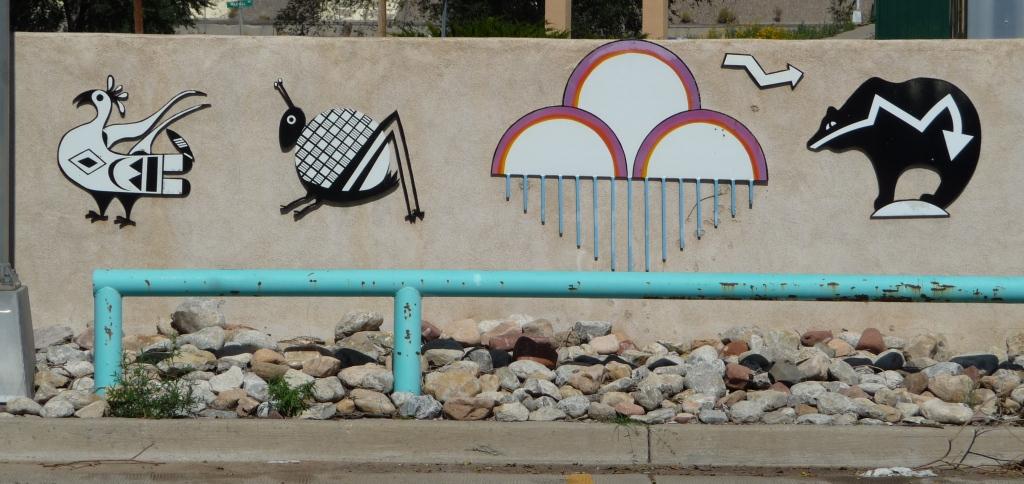 Even a parking lot in Gallup is an opportunity to celebrate art and culture, in this case Mibres images.
We are among those individuals who vastly prefer Gallup to Santa Fe. At this point, some of you will wish to roll your eyes and stop listening. I remember Santa Fe from the early 1960s. Yes, I was a young girl then, but Santa Fe truly had the look and feeling of a small European city to someone from upstate New York. In the intervening decades, Santa Fe’s charm has been whittled away by the demands of tourism and urban planning. With Gallup, what you see is what you get.
Gallup is a railroad town and its tracks define the whole sinuous curve of its old Route 66 highway. The rest of the town is sprawled over its rolling hills and graceful valleys. Because it serves as a reservation border town, Gallup has also attracted the least admirable publicity. Back east, I know people who shiver at the mention it, speaking in shocked tones of horrible car accidents, drunks staggering along streets, and an unnamed discomfort. Friends of ours from Arizona shake their heads at our affection for it, claiming they’d only stop in Gallup for a gas station.
When we visit Gallup, we get a sense of what the West is really all about. We don’t need a movie set, a romantic view of mesas and buttes, or a string of trendy eateries to feel that here is a place where real people live, work, visit, shop, and that life in a railroad town is about staying put while all about one is motion. The people are nice, too, friendly in a way that is far more realistic than people one encounters in a popular tourist destination.
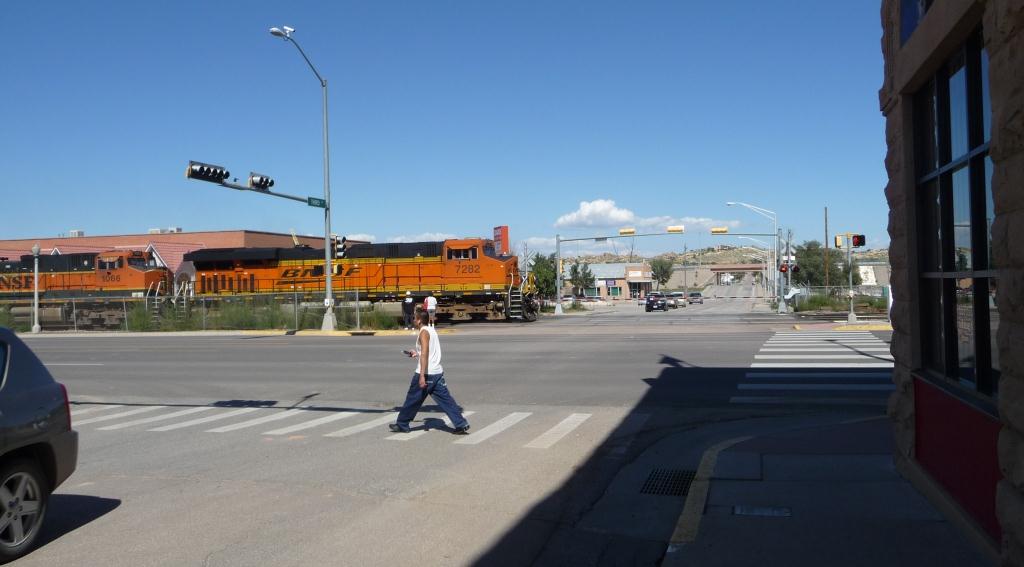 A train arrives in Gallup — one of many arrivals every day.
Recently, I reread some of art historian Lucy Lippard’s 1999 book, On the Beaten Track: Tourism, Art, and Place. I was reading her descriptions of Santa Fe as a tourist destination, and had to agree with a couple of her criticisms. Lippard claims that the visitor’s experience in Santa Fe tends to be artificial, with more of an emphasis on the city as purveyor of artifacts than genuine cultural experiences. At one point, she speaks of the Santuario de Chimayo as being a destination for both religious Hispanos and cultural tourists — or put another way, “those praying and those prying.”
Santa Fe has always been a bit of a problem for me. I had the good fortune to be taken there as a kid of 8 or 9, and thought it an exotic, foreign city at that time, like someplace in Europe rather than America. Of course I’m talking about 1962 or 1963. By the time I got back there in 1986, I felt like the Santa Fe experience had been reduced to that of purveyor status; the shops stood out so much more than any other cultural monuments or sensations.
We’ve always found that buying Southwestern souvenirs that are ridiculous to be part of the enjoyment of this region. I must admit I’ve never gone for the life-like replicas of rattlesnakes, but how many opportunities does one get to buy Mexican jumping beans or shot glasses and salt and pepper shakers bearing the slogan “get your kicks on Route 66?” At places like Indian City along Route 40, you can relax your values and go for the elemental gag. On this last visit, I ended up with colorful large-sized postcards for the corkboard collage I curate in my kitchen. I especially like the one that shows a rusty 1940s Chevy and reads “Historic Route 66 – You Just Like Me for My Body.”